Philosophy

If a superintelligent system can answer any question in seconds, what is left for humans?

Knowing where we come from, being able to act, knowing yourself, and using powerful tools for goals that are your own. At Ainstein, learning develops the whole person: curiosity, judgment, the ability to work with others and the confidence to take an idea seriously.

Our answer

Our answer is old: humanistic education.

Nobody knows what the world will ask of today’s children. So we build what cannot lose its value, in four parts.

  1. Where we come from

    The ideas, texts, science and arguments that built our civilisation. History, language and how the world works give a child orientation before acceleration.

  2. Agency

    Noticing something worth changing, learning what it takes, and following through. Children experience that they can make a difference.

  3. Self-reflection

    What are my strengths? What do I still misunderstand? How do I learn best? Not every child has to climb the same tree, but every child should know their own.

  4. AI as reach

    Directing the most powerful tools ever built toward meaningful change and their own ambitions, and toward their own learning, while questioning what those tools produce.

Discovering that you can make a difference.

We want children to experience their own ability to act: to notice something worth changing, learn what it takes and bring an idea into the world. This is agency. It develops through decisions, effort, feedback and the chance to try again.

AI expands the work a young person can attempt. Education must help them grow into that opportunity: choosing worthwhile questions, judging evidence, imagining possibilities and taking responsibility for the result.

Learning is also a relationship with other people. Children practise listening, disagreeing with care, asking for help and contributing something a teammate needs. Another person’s perspective can reveal a problem or possibility they had missed.

A mentor helps each learner choose a challenge that stretches them and find a way to begin. Some tasks call for patient practice; others open a new field or require a new tool. As understanding grows, so does the responsibility the child can take.

For parents, this gives confidence a concrete basis. A child can point to a decision they made, a difficulty they worked through or something they taught another person. They have experienced what they can do.

How we build this through projects

Motivation

Six steps from structure to ownership.

We do not wait for a child to love every subject. Adults establish the routine, the work begins at a reachable level, and the child experiences effort producing a real result.

Competence changes the relationship with the subject. Success becomes visible, useful to other people, and increasingly self-directed. Independence is built through this sequence rather than demanded at the beginning.

  1. Adults provide structure

    Adults establish clear routines, expectations, and boundaries. A child can begin before motivation arrives.

  2. The challenge is within reach

    The next task requires thought while remaining realistically achievable. The AI proposes the level; a mentor who knows the learner approves the plan.

  3. Effort produces progress

    Feedback and correction turn effort into visible progress. The child can see what changed, what worked, and what to try next.

  4. Understanding becomes visible

    The student explains the idea, answers questions, and applies it again. Success becomes something they can demonstrate and trust.

  5. Progress becomes social

    Peers and mentors give achievement weight. The student becomes useful to a group and is noticed by someone who cares about the work.

  6. Ownership grows with competence

    Responsibility and choice increase as capability grows. The child begins to pursue the standard because it has become part of who they are.

Human agency

Let the work become more ambitious.

An AI tool can help a student code a prototype, compare explanations or explore many possible designs. We want children to use that reach to attempt harder problems and learn what those problems demand of them.

Direct it

Students set the direction

Students choose a question, describe what they are trying to achieve and decide where AI can help. They learn enough about the problem to direct the work, judge suggestions and recognise when they need another person’s expertise.

Question it

AI literacy is a subject

Students learn when a model is useful, how to verify a claim, why confident answers can still be wrong, and how to trace important statements back to evidence.

Create with it

Decisions remain theirs

AI can generate code, explanations or designs. Students examine what it produces, test it and explain what they accept or change. They take responsibility for how the work affects others.

The learning test.

After the project, what can your child now understand, decide or do? We look at their reasoning, the choices they made and whether they can use the underlying ideas in a new situation.

Students reflect on the work in specific terms: What did I decide? Where did AI help? What changed my mind? What can I explain or attempt now that I could not before? Their answers guide the next challenge.

Life competencies

Life skills belong on the curriculum.

Every Ainstein student develops practical capability alongside academic knowledge: budgeting, cooking, communication, relationships, health, digital judgment, and the ability to run a real project.

Demonstrated in real life.

Each competency names its evidence: a budget kept, a formal email sent, a contract read and explained, a meal planned and cooked, or a micro-project pitched. The work enters the portfolio after a mentor witnesses the demonstration.

A record that means something.

Every entry carries its proof and date. Students can present their Life Skills Record alongside the academic transcript and portfolio.

Productive struggle

The right difficulty turns effort into growth.

Learning strengthens when a challenge requires genuine thought and remains within reach. Support increases when the learner is stuck, then fades as competence grows.

Difficulty needs both purpose and calibration

Effort without meaning.

Memorize, regurgitate, repeat. Effort without meaning, the classroom’s oldest mistake.

Result: graduates who associate learning with suffering.

↻ How we do it right
How we do it right

Purposeful effort.

Every hard moment is retrieval of something real: your child’s own weak spot, resurfacing at exactly the right delay. The payoff is visible, the skill goes durable and stays. And the child names where it matters in their life, because discovered value beats lectured value.

Result: effort that compounds, and a child who trusts it.

↻ Back

Ease without growth.

Optimize for speed, celebrate quick wins, smooth every bump away. Learning as a race to lunch.

Result: graduates who collapse at the first real obstacle.

↻ How we do it right
How we do it right

Calibrated challenge.

New skill? Study a worked example first. Getting shaky? Support comes back. Getting strong? Support fades and the problems get real. The tutor gives the smallest hint that keeps your child moving, and struggle is met with kindness, then a better strategy.

Result: confidence that was earned, and holds.

↻ Back

The key word is productive: difficulty with a purpose, support at the right moment, and learning designed to last.

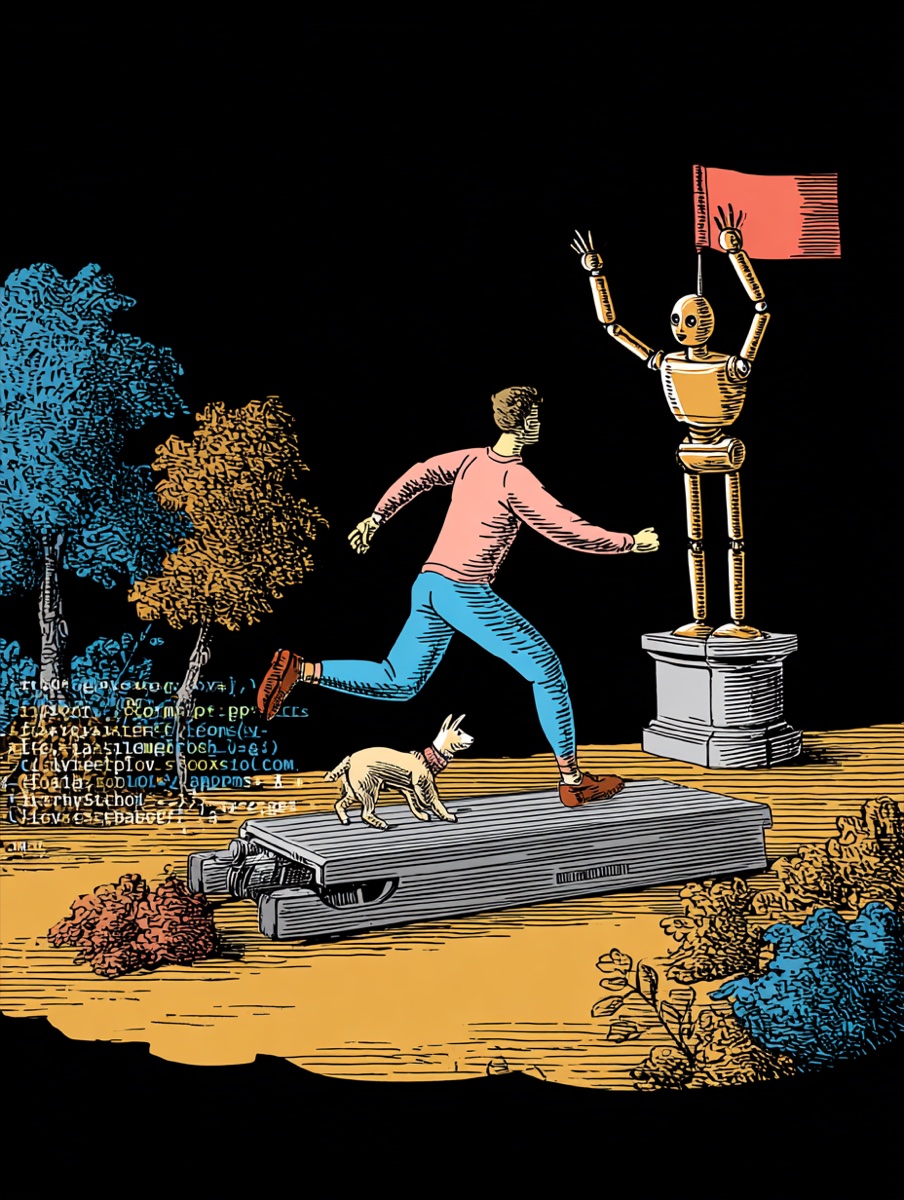
Copper engraving: a runner races on a treadmill toward a robot holding the finish flag
When speed is the goal, someone else holds the flag.

Strengths first

Build a record of what your child can do.

The record that grows over the years is a record of capability: academic understanding, practical competence, interests developed into strengths, and work the student can explain with confidence.

The portfolio

Proof of what they can do

Not a grade average, a growing body of real work: things built, essays written, ideas defended out loud, projects finished. The question is never “where do you rank?” It’s “what can you do, and can you teach it?”

The mirror

Hidden strengths, surfaced

Each week, your child’s self-assessment is held against the actual evidence. When they’re better than they believe, and children often are, they hear it, with proof. Knowing your own strengths is a skill, and we teach it.

Peer explanation

Every child has to explain clearly

Peer teaching runs two to four times a week in groups of five. The student who just mastered a concept explains it, answers questions, and leaves evidence a mentor can review.

Their wins

Victories, in their own words

At real breakthroughs, the moment is saved in your child’s own words, private, theirs. On hard days it’s offered back: you’ve done hard things before; here’s you, saying so. Confidence built on their own record, not on empty praise.

“Not yet” for what’s still growing. Proof for what’s already grown.

Founding families

See where your child would begin.

A 20-minute conversation about your child, the available programs, and the clearest next step.